Showing posts with label Fred Denny | CHAI. Show all posts

Saturday, August 16, 2014

After Africa

 After three months in Dar, I have now made my way back to Ann Arbor.  The timing feels odd as many next steps were just beginning; many of my recommendations revolved around an integrated strategy for the mRDT market, which involved building consensus with other NGOs and the government.  My last afternoon was spent in a government conference room with all the key organizations gaining alignment on the next steps.  It will be exciting to see what occurs next, although most gains are not likely to really be seen for years and maybe even decades.  Motivating individuals to change behavior when the individual benefit is much smaller than the public benefit challenges and requires regulatory change is a goal that will not be solved with a summer’s worth of work.  My appreciation of the complexity around health issues has increased dramatically.  In addition to requiring coordination of many different stakeholders, technology can change much faster than implementation.  Achieving the best health outcomes requires the difficult balancing act of coordinating current products while planning for future changes.  I learned a lot about CHAI’s approach of working with governments and supporting private market and how that contrasts with other NGOs focused on the same outcomes.  My favorite aspect of the CHAI approach is the focus on achieving scale as part of the solution.  By taking a broad approach including governments and other stakeholders, many projects take longer, require more compromise, and change more frequently, but the end result can have a far wider impact.  The policy aspect of the work was the most challenging, but also the area with the most potential for improved outcomes.


So now as I get back to Michigan and gear up for the school year ahead, I am working on processing my summer experience and preparing for the future.  Business school really is incredibly fast-paced with new decisions arriving before everything can be totally processed.  I was able to achieve some of my primary aims in coming to business school in that I was able to stretch my boundaries, experience work life in an emerging market, and work within new business structures-- AND I was able to all of this with my family!  We were able to see many of the positive and negative aspects of living as an expatriate.  My experience this summer has prepared me immensely for the decisions that await me as I make decisions on the next step in my career.  The WDI internship has been a critical step in my step toward becoming a global leader.
1-yr olds can't go on safaris, but a stop at the Amsterdam zoo on the way home meant seeing giraffes up close
Watching the tide go out while in Zanzibar

Wednesday, July 9, 2014

Thoughts on Capacity Building

One concept that has consistently crossed my mind while working in Tanzania is capacity building.  Searching that term returns articles that show the uncertainty that surrounds this concept in international development.  Everyone sees the need to engage in capacity building, but the means to accomplish or even measure this remain elusive.  Many times in this project I have thought about the ability of my recommendations to contain an element of this elusive concept.  One thing that is clear to me after working here for several months is that there is a clear difference between designing a system that works well in a controlled pilot phase and creating solutions that will work across the country even after an organization leaves.  When I first looked at my project and reviewed other approaches taken to solve similar issues, it seemed the difficulty in jumping from pilot to full scale was often linked to “capacity building.” After spending a couple months on my project, I continue to think about how to address capacity in the context of being able to confidently scale up a project.
 
As difficult as pilot projects can be, in many ways they are easy.  By fixing many variables at the outset of the program and investing resources at a significant rate to address the problem, it is often easy to show the potential of a certain product, approach, or process.  The problems really start to arise after a pilot is deemed successful and needs to move forward.  In order to feel extremely confident of successes similar to the pilot, then replicating the same level of investment and variable control would be needed to generate expected results, although these resources are typically not available.  I think this is when “capacity building” starts to enter planning.  If only we could train people so that they think the same way we did when we ran the pilot or even to follow the process we developed over the course of the project, then we could see this succeed on a large scale.  This way of thinking seems very limited and sets up even capacity building for failure.  Just as pilots encounter problems that lead to redesigns, going for scale introduces a significant number of new variables that probably require even more understanding than the pilot.  To think that a training program or following a process developed during the pilot will lead to success at this point seems very optimistic.  I think that capacity building should be rethought and certainly moved to a different place in the pilot to scale method.
 
Instead of looking to add capacity in the transition from pilot to scale, I think looking at capacity constraints should be a critical component of pilot design.  Understanding the local educational system, talent pool, typical compensation, and staff flexibility available for full-scale projects should lead to decisions on how to best structure and design pilot projects.  For example, using locally trained doctors and nurses in a pilot project might make sense, unless the number of locally trained doctors and nurses was insufficient to meet the needs at full scale.  Could doctors or nurses support greater coverage? Can shop-owners be trained?  Can a certification system be developed?  Will the national government accept specialized training?  Waiting until midway through a successful pilot program is probably too late to address the staffing issues.  I think capacity building would better served after doing a thorough capacity assessment.  Incorporating capacity building into a pilot would then determine the potential success of a program using available talent.  Bemoaning the lack of suitable candidates seems a poor excuse for lack of scalability of a pilot project.  Spending more time developing the framework for a successfully scaled project and integrating the capacity needs into the pilot might create fewer successful pilots through fewer controlled variables, but it just might increase the rate of success in transitioning pilots to full-scale projects. 
 
Capacity building is one of many really hard issues to solve.  The requirements to understand many of the critical components of a successful system can be enormous.  Having the resources and time to plan a pilot project can be hard especially for organizations with many goals and stakeholders.  Despite the difficulty of incorporating capacity increases into a project plan, the organizations that successfully included capacity building tended to have greater success and often created new opportunities not available previously.
 
Since capacity building isn't exactly photogenic attached are a few pictures from a recent weekend in Zanzibar:

Aerial view of Dar
Rural Highway in Zanzibar
Fishing Boats at Low Tide in Zanzibar
 

Wednesday, June 18, 2014

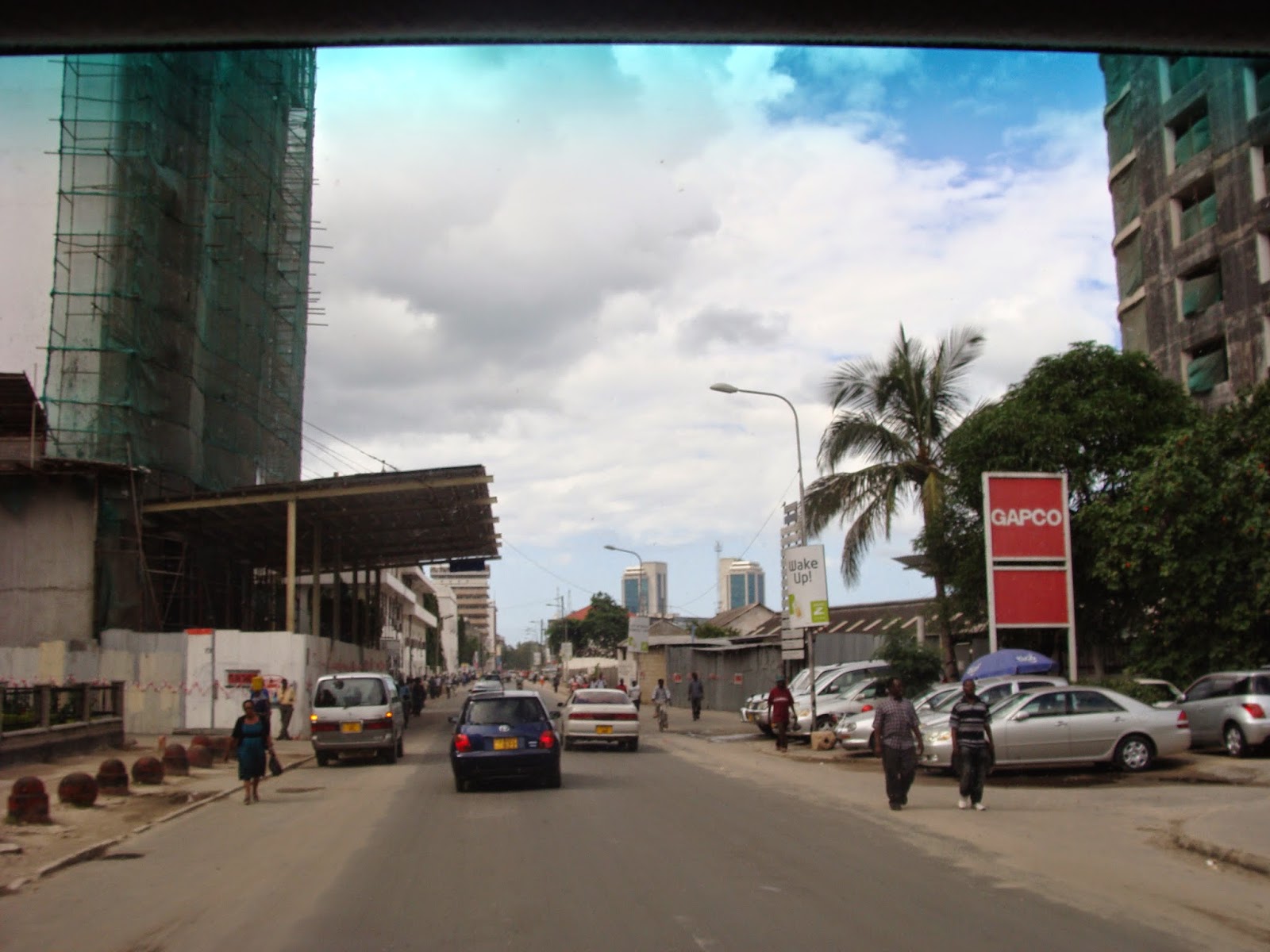
View from the Passenger Window

I have seen a lot of Dar as a passenger crawling through traffic on my way to meetings around town.  The experience has given me a new appreciation for the city and I am sure shaping my experience.  Getting from my place to the CHAI office downtown or to the businesses participating in my project requires a significant amount of time crawling through traffic.  The time in traffic and inability to avoid the delay is something similar to the commutes people have in large US cities like Chicago or New York, but I have enjoyed being the passenger and not the driver.  I don’t have the stress of cars constantly shifting lanes or motorcycles sailing through the backed up cars.  I don’t worry about the inconsistency of street signs or lack of street numbers.  I just get to observe.

Single vendor on right; motorcycle lane in center
I love the number of vendors that pace up and down the traffic on the backed up main roads selling things to a fully captured audience.  Most of the items that are sold make sense, but it is fun for me to notice what else is on offer to commuters like myself.  Many of these salesmen offer the types of products that you would expect for people sitting in hot cars for hours: cold water and soda, cashews, chips, ice cream and fruit.  The most commonly sold fruit are bananas and mangos.  A banana is pretty easy to eat in a car, but a mango seems a bit tougher, however, kitchen knives are also regularly on offer solving that dilemma.   Beyond these immediate use items there are many other items consistently for sale including shoes, a variety of laminated 3’x5’ maps and educational posters, child costumes, and sports equipment.  My favorite unique sighting was a full aquarium complete with decoration and about a dozen fish (sorry camera not pulled out in time.)

Two lanes of right turners: one source of the congestion
My favorite times in the car, however, occur when my driver attempts to beat the traffic jam by weaving through the side streets.  This means shifting to uneven dirt roads with potholes especially large this year due to a heavier rainy season than usual.  In Kiriakoo, the market district these streets often become one-way due to parked cars or crowds.  It has been on these roads that I get to see a greater variety of business in Dar and the natural clustering of similar businesses (like metalworking, lumber, pharmacies, computer shops, and others).  For the pharmaceutical importers that I work with, most have shops here to take advantage of the number of people from across Tanzania that come here to procure materials.

It is probably linked to my time in car and the parts of the city I visit that I see Dar as a very commercial city.  Despite the construction of a new Bus Rapid Transit system, I anticipate the view I have enjoyed from the passenger seat in traffic will continue as opportunities continue to increase in Dar.
Traffic eases off main road near city center

A bonus shot of the local ferry to a local island with a nice beach:
Bongoyo Island near Dar
Wooden Ferryboat to Bongoyo Island
-Fred

Monday, May 26, 2014

Hello from Dar es Salaam!

This summer I am working for the Clinton Health Access Initiative (CHAI) in Tanzania with the Global Malaria team to improve private sector access to Malaria Rapid Diagnostic Tests.  I did not arrive alone for this experience, my wife Kimi and 1 year-old daughter Ava made the trip with me.

We took this in Africa- I promise.
This is my first time in Africa, although having only been in Dar it doesn’t feel like I have really seen a continent, but rather a city.   The Tanzanians I have met so far have been extremely friendly and welcoming-- having a cute toddler has probably helped more than I know.  I thought I would be more overwhelmed than I was on arrival, as I had memories of New Delhi shaping my expectations, but Dar is a smaller city, less dense and due to the amount of English spoken a tad more like home.  A major surprise has been the heavy traffic and the lack of alternatives to driving.  Dar is a city where you need a vehicle to get around, and although getting a taxi or bajaj is not difficult, it has added a new wrinkle to daily planning around even simple things like buying groceries.  My first two days on the job were spent meeting the importers around Dar, and one day I was gone for 12 hours and in traffic for about 7 of those hours.

My project will involve a lot of interaction with the importers of malarial commodities and hopefully some of the wholesalers within the country.  I have wanted to work internationally for a long time, and I think the biggest surprise has been how similar business operates here compared to my time in the US.  A lot of my work experience especially managing business partners, product launches, and incentive structures feels a lot more applicable than I expected.  I am looking forward to the challenge of building connections quickly and brainstorming solutions that can have a tangible effect on malaria management in Tanzania and the rest of East Africa. 

First time at the India Ocean
-Fred
MBA 2015