Showing posts with label Soomin Kang | ILO. Show all posts

Friday, August 15, 2014

Thanks to Phnom Penh & WDI!

Hi guys! Today, I want to wrap up my internship by writing my final blog!  The things I want to talk in general are my personal opinions on Cambodia and the International Labour Organization (ILO).
Since I am from Republic of Korea, I was very confident in living in Cambodia when I was selected as a WDI fellow.  My confidence, I guess, came from my nationality, my frequent trips to Southeast Asian countries, and my previous employment experiences in the navy!  However, as you may predict, there were many new challenges I faced such as weather, language, public order, sanitary facilities, etc. Even though those challenges sometimes gave way to me, I really enjoyed staying in Cambodia. I got to know how to respect Cambodian long culture and tradition, and how they live together.  Maybe, these positive impressions on Cambodia were the main motivation for me to work hard to improve the labour quality of Cambodians.

Ah! I have a special picture for you guys. The landlord of the apartment I stayed was a lawyer as well.  His home was on the first floor, and sometimes I visited his home because his family is so big with 13 members. Wow… I have never seen any family more than 10 members!


Doesn’t this home look so cozy and traditional?  If you read my third blog, you may remember the discussion on Buddhism in Cambodia. My landlord’s home also has a small Buddha statue at his home. I wanted to share this picture with you!  Of course, most Cambodian people are not affluent enough to have a big and clean house as my landlord's.  But, I wanted to just emphasize on the Cambodian’s love for Buddhism.

Thanks to Cambodia’s amazing potentials to grow, many foreign companies and UN agencies, such as Asian Development Bank, UNHCR, or UNDES, are located in Phnom Penh. If you want to work in an international organization, or to employ your skills and knowledge  meaningfully, you may find out that Southeast Asian countries are the best places for you. That’s why the ILO also regard Cambodia as a promising country with tremendous growth potential. Some people may think Cambodian people are not as happy as people in other countries due to poverty and less developed civilization. However, this is totally wrong. Cambodian people know how to be satisfied with what they possess, although the life style is not luxury or splendid, and the value of life in a spiritual aspect.
 
From this picture below, you can see the street foods that Cambodian usually eat out with friends or families. 

Personally, I feel so thankful for all staff in the ILO who were eager to support me whenever I needed help. They were very interested in my studies in the University of Michigan, and WDI as well, which makes me feel proud of being a WDI fellow during my internship. With even broader view toward the world, I am looking forward to sharing my 2014 summer in Cambodia with you soon. 


Thursday, July 31, 2014

Buddhism in Cambodia

Hi Guys! Today, I am going to talk about the Buddhism in Cambodia. This is because every day I commuted to work, I saw many monks in the streets. I asked lots of questions about Cambodians’ religion.  About 95% of Cambodian population is a Buddhist.  Did you know that there are different kinds of Buddhism?  The Buddhism prevalent among Cambodians is “Hinayana Buddhism”.

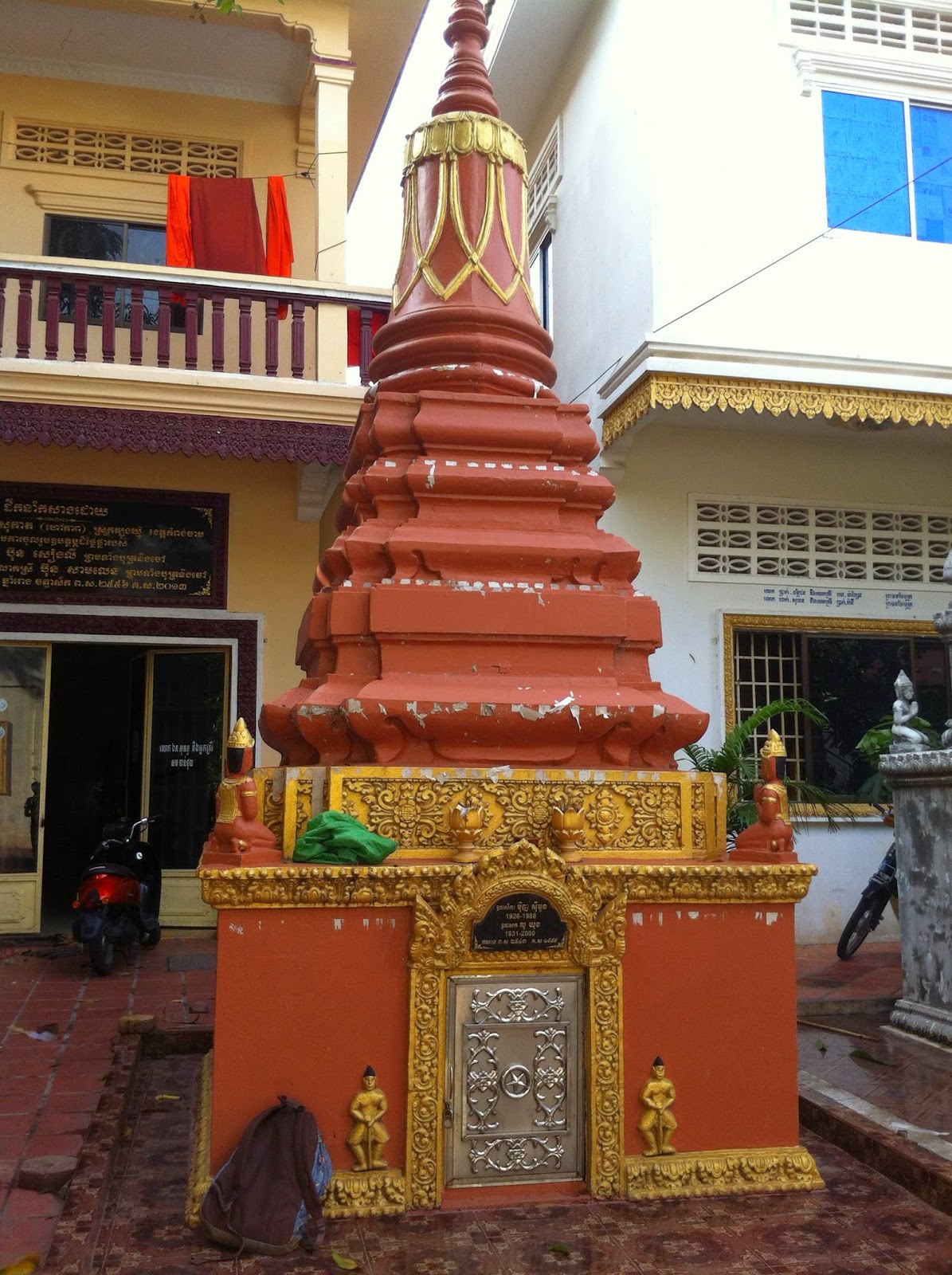
You can notice this fact easily, based on the picture of monks. Their costumes represent Hinayana Buddhism. Because I am Korean and my family believes in this religion, I think I am very familiar with this religion, Buddhism. However, how monks are dressed is considerably different each other, so that’s why I could figure out the Buddhism in Cambodia is different with that in Korea. According to my search, the origin of Buddhism was one, but as time went by, the Buddhism was divided into several parts. One of them is Hinayana Buddhism.

Buddhism is a set of system for achieving enlightenment. Cambodian Buddhism emphasizes a belief in reincarnation, and one's position in life is believed to arise from actions in his or her past life. Respect for Cambodian royalty can be in general rooted in this belief. King's high station in life can be interpreted as the result of good deeds in previous lives.

I went to a small temple near my housing. Many buildings and towers were decorated in the style of Buddhism. The small towers in the second and third pictures are for when monks pray every morning. If you visit Cambodia, it is so so so easy to find monks and temples wherever you go. I think Cambodian's live is equal to a life as a Buddhist. If a monk visits a housing in the morning, any Cambodians are very willing and happy to give some foods or money to the monk. They think this is a way of being responsible as a Buddhist. Then, the monk recites the Buddhist scriptures for a while for the person who presents an offering to Buddha. I wanted to take a picture of this scene, but I couldn't because I could interrupt them.   


Even though how monks are dressed or the architectural styles between “Hinayana Buddhism” and “Mahayana Buddhism” is very different, people’s minds toward believing Buddha is same in that they want to be happy and they perceive lifedeath and rebirth as a continuous cycle. I think Buddhism is the most motives for Cambodians to survive from exterior attacks in their history. 

Tuesday, July 29, 2014

Reaching other Organizations for Improving Cambodians’ lives

Hello Guys!  I am Soomin! Today, I want to talk about one of my assignments in Cambodia, which is to get useful responses from other organizations applying the C-BED training tool.

First of all, I want to show the building where I worked.


Can you see the yellow buildings in this picture?  These buildings are called ‘Phnom Penh Center’ located in the center of Phnom Penh.  In these buildings, there are a variety of offices for different organizations. The ILO uses one of the buildings.

During my internship, I had tried to reach other organizations, such as governmental organizations, NGOs, and private sector organizations, to get their responses after their experience with C-BED.

To remind you of the C-BED, there is a brief summary for you.
CBED is an ILO training tool which establishes the capacity of current or aspiring entrepreneurs to start or improve their businesses without requiring external trainers or facilitators. CBED’s simple design encourages community facilitators to guide training sessions by providing instructions for participant-driven individual and group activities. Consequently implementation of CBED is very low cost and has great utility in poor or vulnerable communities that would traditionally be inaccessible due to social or geographical isolation.

The reason why I tried to contact other organizations is that the ILO had piloted the C-BED training package until the beginning of this year. We need feedback to enhance the C-BED training tool and make it more solid than before.

The survey period was from 03 July 2014 to 17 July 2014. The primary objective of the survey is to map the status of C-BED program implementation in Cambodia, by measuring the overall satisfaction with C-BED, which is designed to inform us how to enhance a broader framework to monitor, manage, and report on the impact of C-BED.

Twenty five organizations were asked ten questions through either accessing a link of Survey Monkey website or filling out a Micro Word file. The survey questions are about their previous involvement with C-BED in terms of how they participated, how many times, what kind of challenges they had, and the effectiveness of C-BED.

A partial list of partner organizations include ‘Centre d'Etude et de Développement Agricole Cambodgien’, ‘Khana’, Pour un Sourire d'Enfant Institute, etc.

I called each of the respondents to get more detailed information and I met some of them in person. J  Their feedback was very useful that I could do my assessment and give my recommendation to supplement the current C-BED training tool, and to find out the current status of C-BED in Cambodia.

I hope to share this with U of M students soon!!

Thursday, July 17, 2014

Welcome to the Kingdom of Cambodia!!

Hello!  I am a dual degree graduate student pursuing a Masters of Public Administration (MPA) and a Masters of Applied Economics (MAE) at the University of Michigan.  Since May 25, I have been working with the International Labour Organization (ILO) in Phnom Penh, the capital of Cambodia.  My assignments here are to increase the reach of the ILO’s small enterprise support efforts and create new approaches that facilitate this effort.

This is my first visit to Cambodia, even though I’ve been to many Southeast Asian countries, such as Philippines, Thailand, and Vietnam. Cambodia has common things with other Southeast Asian countries, but features its singular cultures and long history which cannot be found in other countries.

After regaining its political stability, Cambodia’s economy has grown rapidly and enjoyed sustained growth. That’s why there are a lot of foreigners visiting to do business here and many nonprofit organizations eager to establish advantageous programs for Cambodians. C-BED, an innovative methodology developed by the ILO, is also one of those programs.  Last year, Jordi Prat Tuca, the first WDI intern working for C-BED in the ILO, supported the sub-regional program on C-BED, identifying new governmental and non-governmental partners in Cambodia, enabling them to understand how the C-BED approach works, and how it fits with their own services. This year, my assignments are a little different in that my specific tasks are to analyze how C-BED has linkages and add value to programs at the national level in Cambodia, and to develop a working knowledge of community-based training methodologies and development approaches to enterprise development at the base of the pyramid.

I want to introduce my office located in the Phnom Penh center, and a few colleagues.


This is the front of the building where the ILO places, and the ILO office is on the third floor.


Can you see ILO’s logo?


The ILO office has been under construction due to reducing the size of the office, and last week, it was finished. The lady in the above picture is the receptionist of the ILO, and she is also responsible for administrative assistance for staff.

I asked my college, Lody, to take a picture together!!!  She is so kind and awesome!  Lody is a program assistant working for the ILO for more than 4 years.  She is so knowledgaeable about Phnom Penh that with her help, I could handle many logistic problems easily.
Except for the ILO, there are many UN agencies in Phnom Penh, which means Cambodia has a potential to grow  and needs strong external support to develop the whole areas in terms of economic, politics, and society. I am very happy I can be of help as well.  Personally, I am so happy with this great opportunity to experience the ILO because I have long wished to utilize my academic and professional experience, combined with my passion and commitment to participate in the development of the Southeast Asian economy.