Showing posts with label Snehanshu Mahto | Wello. Show all posts

Friday, August 15, 2014

Thanks to Mumbai, Wello and WDI!

After spending ~7 weeks in the field, Mumbai  was my home for next 5 weeks. Crazy rain and high tide of Mumbai welcomed me.  Small tea stall near Wello Mumbai office was my morning destination for every day. It was a completely different experience at Wello Mumbai office compared to field experience. We celebrated various occasions with team members. One of such occasions was ice cream week.  On this occasion, entire office celebrated with natural ice cream. This brand is very famous in India. Fig-1 shows combination of yummy coconut tender and chocolate ice-cream.   

Fig-1: Celebrating icecream week at Wello, Mumbai office.
  In Mumbai office, I had to compile all my findings from field and use them to devise pricing strategy. In two weeks time, I was able to complete work on pricing strategy. CEO, Cynthia Koenig, mentored my work personally and guided me as when needed. She also accommodated my request to work on due diligence. Due diligence was an area where I wanted to work. Apart of due diligence, I further worked on financial models developed by previous WDI intern. Overall It was a great learning experience at Mumbai office. 

Logistics experience was also awesome. My residential place was hardly 15 minutes away from the office. Seashore was hardly at 5 minutes walking distance from my residence. Every evening I used to spend near seashore and experience cool sea bridges. However, I couldn’t go to any location within Mumbai or around as I used to return to Delhi on weekend. We also found a good restaurant for a great lunch every day. I was surprised to know the price of lunch that was just USD $0.83 per person. Fig 2 shows my lunch place and a full lunch plate.

On the final day, couple of surprises were awaiting me. A surprise team dinner at awesome place gave me a feeling that I should never leave such a caring and supporting team. Furthermore, a customized t-shirt with Wello logo made me emotional. Fig-3 depicts me before and after joining Wello.

With this, I would like to thank everyone at Wello specially Cynthia, Shradha, and Richard for their awesome support. Additionally, WDI team for their continuous support and reminding me for blogs and deliverables at regular interval of time. My special thanks goes to Sinia for her support from application process to till the end of the internship.

This is not the end of the journey with WDI and Wello but starting of a relationship that will remain for the life. 
Fig-2: My lunch and restaurant in Mumbai

Fig-3: Before and after joining  Wello 
 

Monday, August 11, 2014

Meet two users of water wheel: a life changing product for them

I was on my second field trip to Yavatmal.  On my first day of pricing experiment, I met Boni Bai. As soon as my car reached in her village, she took a water wheel and initiated demo of the water wheel to villagers. I felt that she was already aware of the product. Further discussion with Boni Bai realized me that, she was looking for waterwheel since last six months. I was very delighted to experience this kind of opinion among water wheel users. Let me share some of these experiences:

Let me introduce Boni Bai: 

Fig-1: Boni Bai : a water wheel user
 
Boni bai, a housewife and daily wage earner, lives with her husband in Marutipur village. She collects water for her domestic usage and cattle. She collects water for her family and spends ~ 2 hrs on water collection. She is 57 years old and experiencing problem in her back and neck. Waterwheel is most-desirable product for her life. So, she decides to participate in pricing experiment.

On my next trip, I visit her village to gauge willingness to pay. Unfortunately, she was not available. Her husband participates in the game and price the product at a much lower price. So, I decide to take it back (As per the experiment rule).  On the next day, she meets me again in the field and says- “I am purchasing waterwheel at the price decided in experiment.” I told her about her husband’s opinion. She says that her husband can’t understand the value of the product as he doesn’t collect water. She also argues with her husband for cash payment and says to her – “If he doesn't purchase WW, she will not collect water from next day.” Finally, she purchases waterwheel and shares her reduced pain and reduced water collection time with her village members.
Now, Let me introduce another water wheel user  Manohar Gawre: 
Fig-2: Manohar Gawre: a water wheel user

Meet Manohar Gawre - a dedicated school teacher and the unofficial community leader from Kundi, Maharashtra. His quaint village is hidden amongst endless fields with winding-stone pathways, narrow lanes, smiling children, and colourful homes. It is also a village where the nearest well is over 1.5 kilometers away. He spends ~ 2.5 hrs per day to collect water. 

One day when visiting a neighbouring village, Manohar came across a strange tool being rolled across the terrain, the Water Wheel. He felt it immediately: this is the product for the people of Kundi. He decided to present what he had seen to the entire village at the next panchayat (community) meeting - during which he also compiled a list of 58 families who have no other means to transport water other than head loading and interested in the Water Wheel.

A few days later, word spread that a Wello representative was visiting Bhimnara, a neighbouring village 8 kilometers away. Upon hearing this, Manohar knew that this was his chance to get Kundi noticed. So, that afternoon, without regard to the distance or the 49oC heat, he picked up his list and walked across the rough terrain to speak with Wello. His reason: “I had to tell them to give us WaterWheels.” 

Seeing such enthusiasm, We decided to deploy two water wheels in kundi so that villagers can experience benefits of water wheels. I am closing my field notes with these positive message from users. 

Next time, I'll discuss my experience in Mumbai office of Wello. 


Sunday, July 27, 2014

Few local tips to avoid heat wave exposure and Water problem!

Travel to the field and tips to avoid heat wave exposure:

My rural experience in India was concentrated in different villages of Yavatmal district in Maharashtra. Yavatmal is located at a distance of 700 kms from Mumbai.  This area is famous for 3 different reasons a). cotton cultivation, b). extreme dry heat region of India (Maximum temperature goes up to 120 0F)  and c). severe water problem.

I spent six weeks in this region when temperature was ranging between 1100F and 1200F.  It was a challenge as well as good learning experience to deal extreme dry heat. Some of the tips to survive in high temperature zone are a). drink water at regular interval (prefer bottled/mineral water), b). avoid sun light during peak hrs. If it is essential to come out in extreme sunlight, use cotton towel on head to avoid heat wave exposure. c). keep essential medicines such as electrolytes, paracetamol (fever) and  medicine for headache, and d). use light during night to roam in village areas (I saved myself from deadly scorpion couple of times. Fig-2 shows my second encounter with deadly scorpion of the region).
Fig-1: My home for six weeks in the field
 
Fig-2: My second encounter with a deadly scorpion
Fig-3: My breakfast and tea in the field
During my field visit, I met wonderful people of NGO partner. They  were very helpful and provided good support while staying in the field. I wouldn't have been able to work in such extreme conditions without NGO and organization's support. 
Fig-4: My team during field visit (2nd from left is head of NGO) 

Water problem in the region:

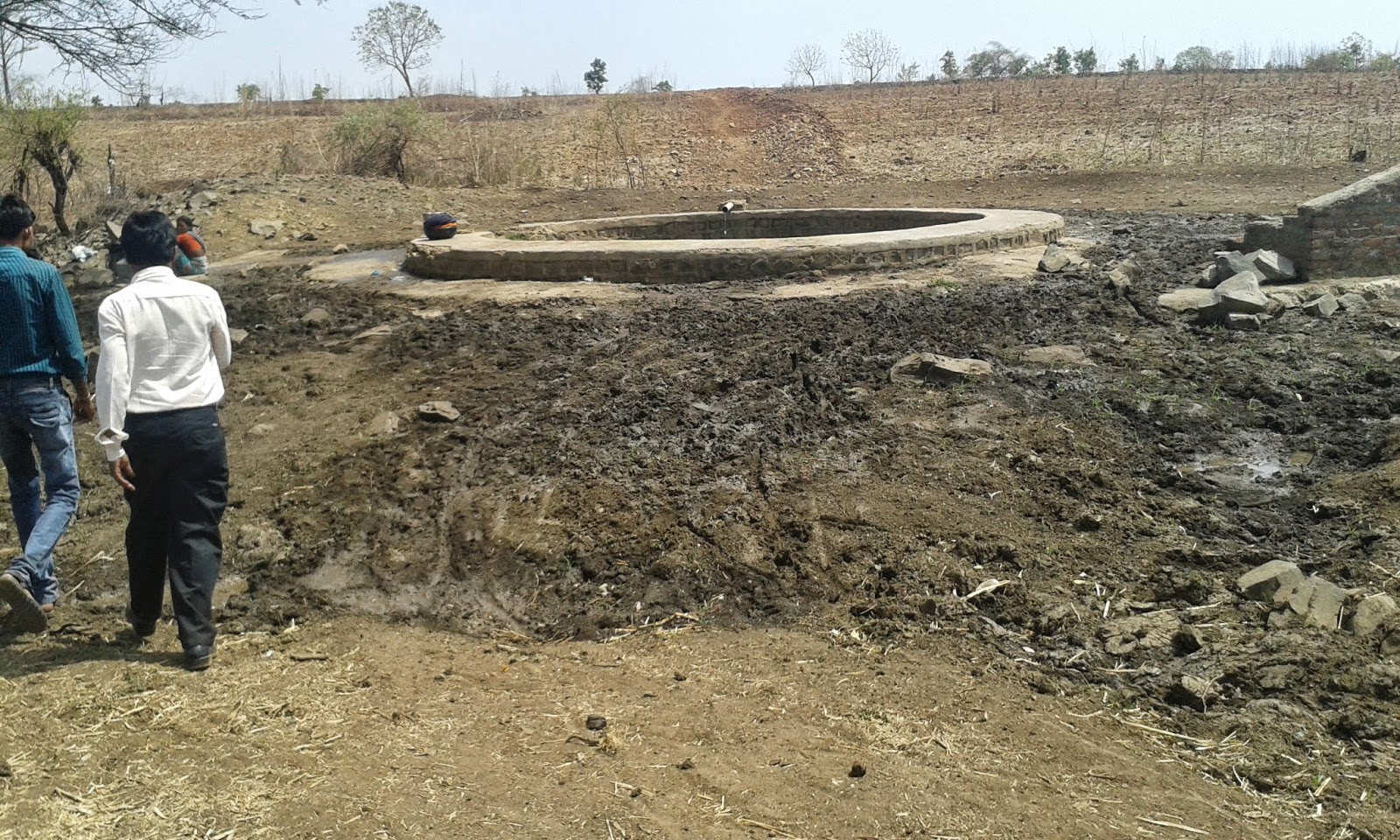
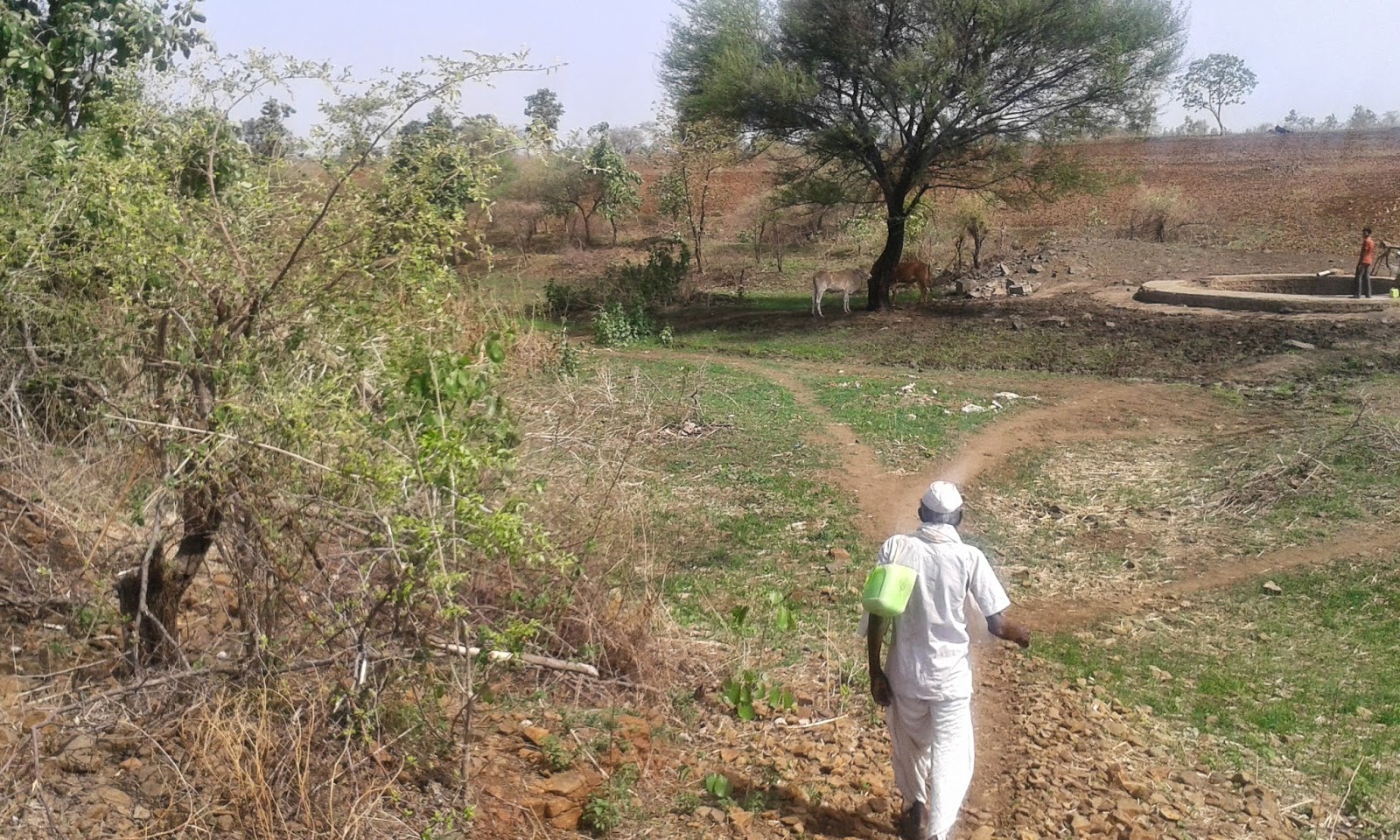
My work was concentrated around Palaskund village of district Yavatmal. This village has ~100 families. Sources of income for this village are daily wage, farming or both. It has four water sources.  Ironically, not a single water source is available throughout the year. The nearest water source is at a distance of ~200 m and farthest water source is at a distance of ~3 Km.   Fig-5 shows most common water source. Fig 6 shows dried well. People are collecting water.  Fig 7 shows path to common water source during summer season.  

Fig-5: Common water source of palaskund village
This village has highest number of waterwheel user. A clear navigable path through stony cotton field in fig-7 is an impact of waterwheel.  
Fig-6a: Dried well of village palaskund
Palaskund was my first village in Yavatmal. I visited three times to this village. When I reached to this village for first time, It was noon. Temperature was ~114 oF. I walked straight to well which was current water source. I can roughly say that the distance will be around ~1.5km from village. I started feeling headache as I walked down to well in such extreme temperature. It gave me a thought that how are villagers managing water collection from this water source. Further, I was shocked when I reached at water source. There were hardly 10-20 li water left in the well. However, more then 5 families were trying to take some portion of water. It is clearly depicted in figure-6. Water in the well comes from another village which is around 5 km from Palaskund. As a result only limited water is provided to palaskund during summer. People wait since mid night to collect water once water is accumulated in the morning.  
Fig-6b: Villagers collecting water  
Further discussion with villagers revealed that there is another water source which is ~3 km from village. However, only few people collect water from distant water source as it takes more than 1.5 hrs for one trip. In such location, waterwheel works as a life saving product. It doesn’t only reduce drudgery but also saves time and increases opportunity to earn. This kind of water problem is present in almost all villages where I visited in six weeks period.

Next time, I’ll discuss about my experience in actual field demo and people’s enthusiasm for waterwheel. 

Fig-7a: Path near well

Fig-7b: a clear navigable path on the way to well.

Fig-7c: A clear navigable path to Well. 
 

Sunday, July 13, 2014

Water problem in India and my internship!

India has 4% of water sources of the world, while it supports 15% of the world population. Additionally, available water source is not uniformly distributed across the nation. As a result, few areas of India have water surplus and few areas have limited access to water. This kind of situations is present across developing nations or underdeveloped nations.  

One of the major problems due to spatial variations in water availability is unavailability of water source at home or at the point of consumption in water deficient areas. In such areas, people, mainly women, carry water on their head. They spend on average ~1.5 hrs per day in water collection. Distant water sources not only result in the physical problem but also reduced opportunities to earn more. A person in water deficient areas earns lesser than a similar background person in water surplus area. 

Fig-1: Waterwheel: A kid pushes filled WW during a demo
I am glad that this summer I am spending my time with WELLO working on WATERWHEEL (WW). Figure - 1 shows WW. WW reduces both aforementioned problems of people at BoP: base of the pyramid.  The WW can carry 50 li water in one trip without any head load. Further, It reduces overall water collection time by 1/3rd as it can carry 3 times more water than a head load container. Fig-2 shows traditional water collection method by Indian woman. This work gives me an internal pleasure of contributing to the society in which I spent my entire childhood.


 Fig-2: An Indian woman carry water on her head.           
My project at WELLO is composed of following work streams a). pricing of WW, b).forecasting demand, c). formulating distribution strategy and d). preparing financials. So far, I have completed first two objectives and rest of the objectives are to be completed in next 3 weeks.

Pricing of WW is an interesting topic. I met 200 people across 20 villages to discover people’s willingness to pay for the WW. Pricing experiments also helped me to introduce WW to more than 5000+ people through product demo and word of mouth. 

Keep reading my blog to discover a). water problem in India and globally, b). my journey to villages while discovering WTP: willingness to pay for WW and c). impact of WW on the life of people at base of pyramid - both on physical as well as on economic conditions.